Meta Muse Spark Open brings 816 billion parameter open weights to Mac desktops
By Moumita Sarkar · · 4 min read
What happened
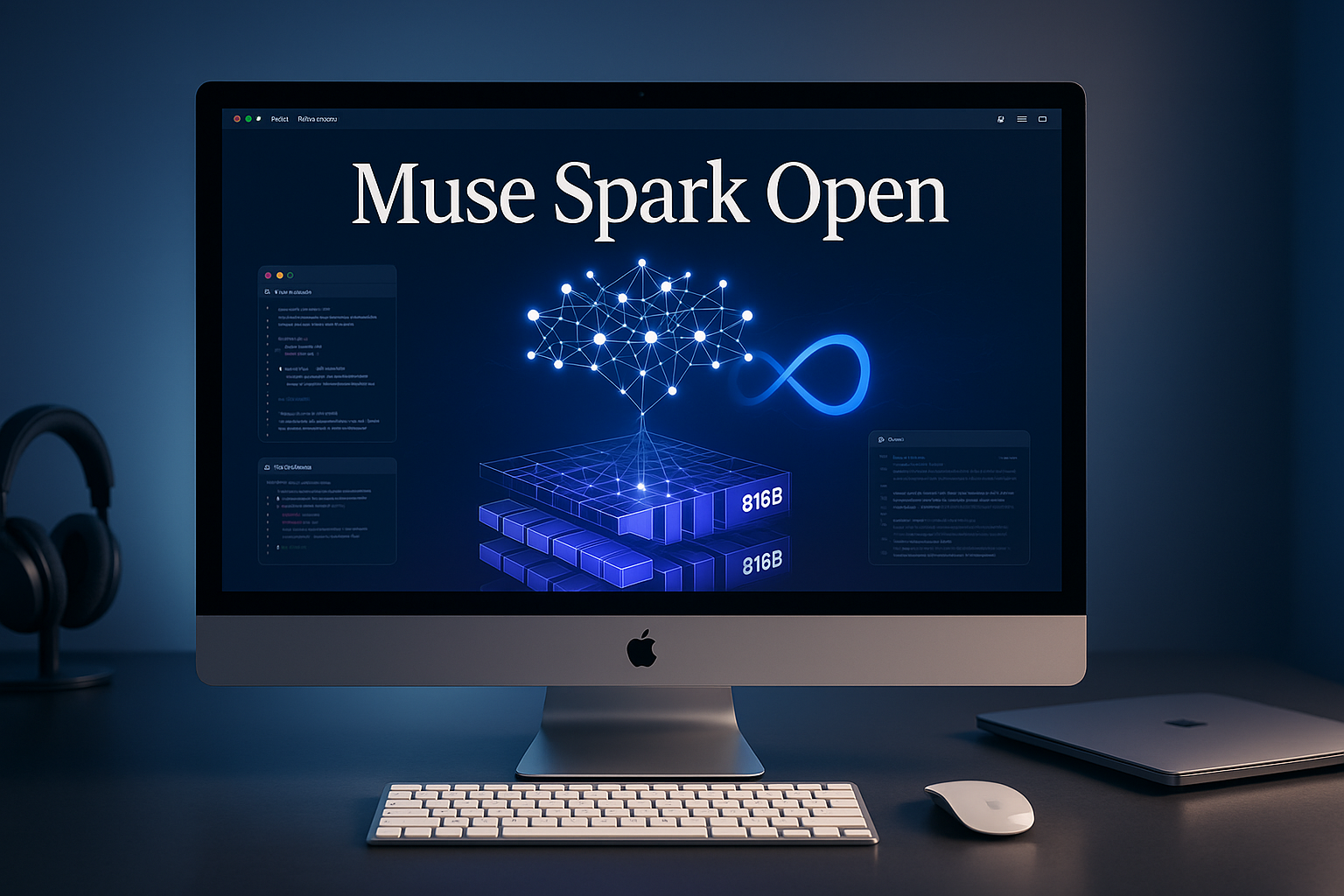
Meta has unveiled Muse Spark Open, an 816-billion-parameter open-weight AI model that, according to the announcement coverage, can run on comparatively affordable consumer hardware. VentureBeat reports that Meta benchmarked it on a pair of M5 Ultra Mac Studios, though the memory configuration was not disclosed.
Key details, plainly explained
The headline number is 816 billion parameters. Parameters are the learned weights of a model, and they are one rough proxy for model capacity, but they do not tell the whole story about cost or speed. Muse Spark Open uses a mixture-of-experts architecture, usually shortened to MoE. In an MoE model, the system contains many expert components, but for a given token it routes computation through only a subset of them.
That matters because Muse Spark Open reportedly activates 42 billion parameters per token, not all 816 billion. The full model still has to be stored and served somehow, but each generation step uses a much smaller active slice. For developers, this distinction is central: total parameters influence memory and deployment complexity, while active parameters more directly influence the amount of compute required for each token.
The model also supports a context window of up to 1 million tokens. Context is the amount of input the model can consider at once: prompts, documents, chat history, code, transcripts, logs, and other material. A million-token window is large enough to change application design, because some workloads that previously needed aggressive chunking or retrieval pipelines may be able to pass far more source material directly into the prompt.
Muse Spark Open accepts text, images, video, and audio as input, but it outputs text only. That makes it multimodal on the input side, not a full image, audio, or video generation system. The open-weight framing is also important. Open weights generally means the model weights are available for others to run or inspect under some terms, but it is not automatically the same as fully open-source software. The exact practical freedoms depend on the license and release conditions, which are not specified in the provided report.
Why it matters
The most interesting part of the announcement is not just that Meta has a very large open-weight model. It is the claim that such a model can run on two paired Mac desktops. If that proves practical beyond Meta's benchmark setup, it narrows the gap between cloud-only AI infrastructure and local high-end workstation deployment. For engineering teams, that could make serious model evaluation possible without immediately committing to specialized server clusters.
Local execution changes the decision matrix. Teams working with sensitive code, customer documents, research data, media archives, or regulated workflows often face hard trade-offs when sending data to a hosted API. A capable open-weight model that can run on hardware an organization owns gives architects another option: keep more data local, control the runtime environment, and tune operational policies around internal requirements. That does not remove the need for security review, access control, logging, and compliance work, but it can reduce dependence on a remote model provider for every inference call.
The Mac desktop angle should still be treated carefully. A pair of M5 Ultra Mac Studios is not the same thing as a typical developer laptop or commodity office machine. The unknown memory configuration is a major missing detail, because large open-weight models are often constrained as much by memory capacity and bandwidth as by raw compute. Paired-machine inference also introduces system complexity: the model has to be partitioned, data has to move between devices, and performance depends on the whole serving stack, not just the model architecture.
For product teams, the 1 million token context window may be more immediately relevant than the parameter count. Long context could simplify products that analyze large codebases, legal records, support histories, meeting transcripts, design files, or multimodal evidence. But long context is not free. Larger prompts can increase latency, make behavior harder to predict, and encourage teams to dump data into the model rather than design careful information flows. The best products will still need evaluation harnesses, input selection, error handling, and clear user expectations.
For founders and technical decision-makers, Muse Spark Open is a reminder that the open-weight market is becoming strategically important. Open weights can reduce vendor lock-in, improve negotiating leverage with hosted providers, and let teams build differentiated infrastructure around their own constraints. The trade-off is that owning the model path means owning more operational burden: deployment, monitoring, cost modeling, safety controls, upgrades, and incident response. A model that runs locally is not automatically cheaper or simpler; it is more controllable.
What to watch next
The first open question is reproducibility. Meta's benchmark used two M5 Ultra Mac Studios, but the memory configuration is unknown. Until independent teams can report actual setup requirements, throughput, latency, and stability, the consumer-hardware claim should be viewed as promising rather than settled.
The second question is licensing and access. Open-weight releases vary widely in what they allow for research, internal use, commercial products, redistribution, and modification. Developers should not make product plans until they understand the release terms and whether those terms fit their business model.
The third question is real-world quality. Benchmarks can identify strong candidates, but they rarely capture an organization's actual workloads: messy documents, ambiguous media, domain-specific language, long-running agent flows, and adversarial inputs. Muse Spark Open will become more meaningful to the market if independent evaluations show that its long-context and multimodal input capabilities hold up outside curated tests.
Finally, text-only output defines the near-term product boundary. The model may be useful for analysis, summarization, coding assistance, search, classification, and multimodal understanding, but teams that need generated images, audio, or video will still need other components. The announcement is a significant signal for open-weight AI, but the practical winner will be the model that combines quality, deployability, licensing clarity, and predictable operating cost.