Amazon Leo Nears Commercial Space Broadband Launch
By Moumita Sarkar · · 4 min read
What happened
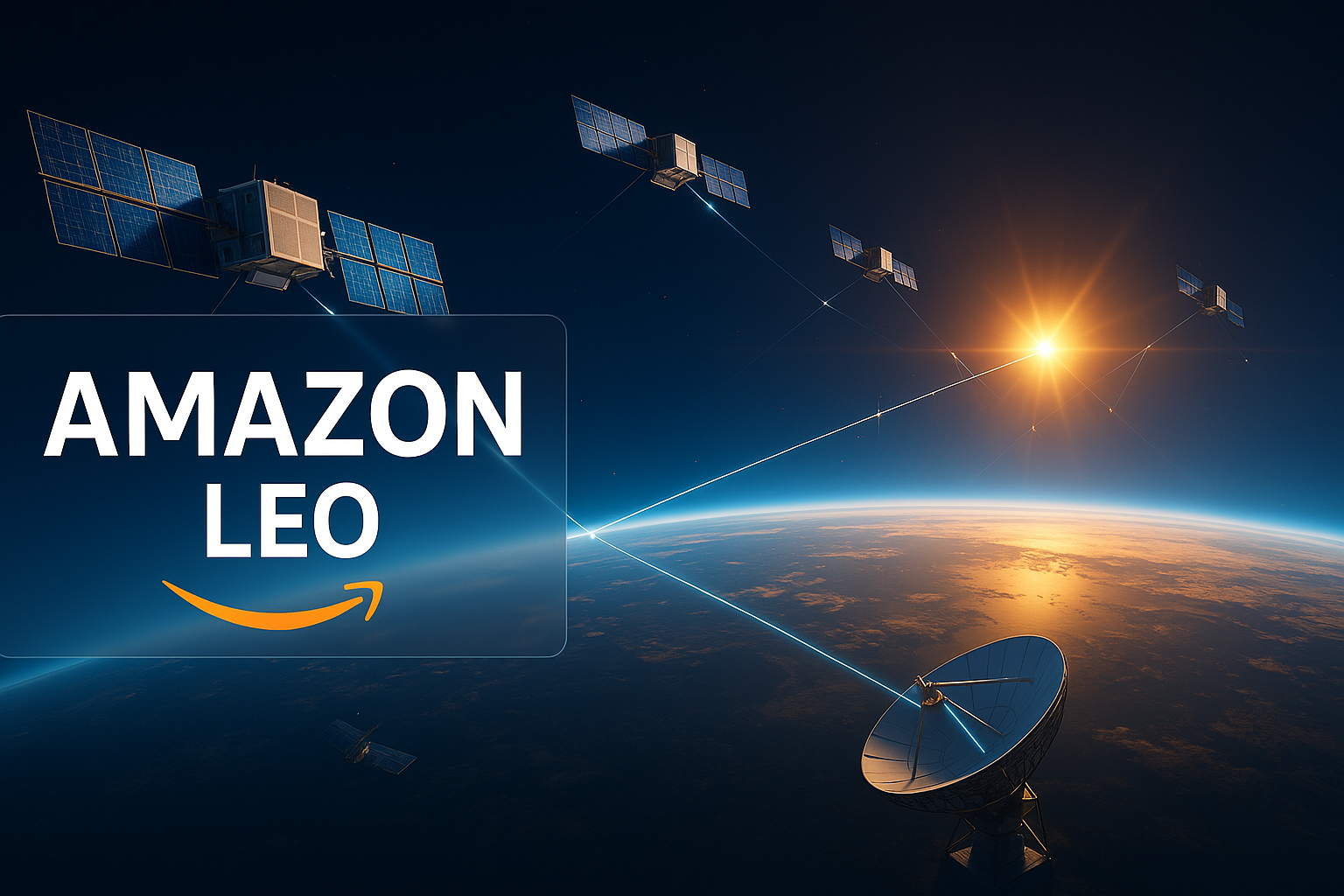
Amazon's Leo satellite internet effort has crossed a manufacturing milestone: the company has built its 1,000th satellite and says it can now produce a handful of satellites per day. According to Ars Technica, Amazon is also approaching its first commercial space broadband service, with rollout described as only weeks away.
The next launch steps are tied to Vulcan rockets: one upcoming return-to-flight mission will carry Amazon Leo satellites, and another Vulcan rocket is being prepared to launch more Amazon satellites this year. For developers, founders, and technical buyers, the news is less about a single launch and more about whether Amazon is close to turning a capital-heavy satellite program into an operational network service.
The key details, explained plainly
A satellite broadband system depends on three linked capabilities: manufacturing enough spacecraft, launching them reliably, and operating them as a network customers can actually use. The 1,000th satellite matters because a constellation is not a one-off asset. It is a distributed infrastructure platform, and scale determines coverage, capacity, resilience, and the rate at which the operator can replace or expand the fleet.
Amazon saying it can build a handful of satellites every day is also significant. In software terms, this is the difference between a prototype and a production pipeline. A satellite program does not become commercially useful just because the first units work; it needs repeatable assembly, testing, logistics, launch integration, and operations. Manufacturing cadence is therefore a leading indicator of whether the service can grow beyond a limited initial footprint.
The Vulcan reference is important because launch availability is now part of the product roadmap. A return-to-flight mission means the rocket is coming back after a pause or issue, and Amazon's deployment schedule is connected to that rocket's successful operation. Another Vulcan being prepared this year suggests Amazon is not treating the next flight as an isolated event, but the actual commercial service still depends on launches, orbital deployment, and readiness on the ground.
Space broadband is simply internet access delivered through satellites instead of terrestrial fiber, cable, cellular, or fixed wireless. For application developers, the relevant technical properties are not only headline bandwidth. Latency, packet loss, jitter, coverage boundaries, terminal behavior, failover characteristics, and support models will determine whether the service is suitable for real products. The provided news does not give those performance details, so they should remain open questions rather than assumptions.
Why it matters
For engineering teams, a new commercial satellite broadband option can change architecture decisions at the edge. Products that operate in remote facilities, temporary worksites, maritime environments, rural regions, or locations with weak terrestrial infrastructure often have to treat connectivity as intermittent and expensive. If Amazon Leo becomes broadly available and dependable, some systems could move from store-and-forward designs toward more interactive cloud-connected patterns. That does not eliminate offline-first engineering, but it can shift the trade-off.
The most practical implication is redundancy. Even organizations with decent terrestrial connectivity may want an independent path for critical operations. Satellite broadband can serve as a backup link for retail sites, industrial monitoring, emergency response, remote offices, or field equipment. The architectural question is whether applications are built to degrade gracefully: can they queue writes, reconcile state, retry idempotently, and expose useful status when the link quality changes? A satellite link is not magic fiber in the sky; resilient software still matters.
For founders, the opportunity is not just reselling connectivity. New coverage can make previously awkward product categories more viable: asset tracking with richer telemetry, remote diagnostics, field collaboration tools, autonomous equipment supervision, and cloud-managed infrastructure in places where broadband was a blocker. The catch is that early markets may be constrained by availability, hardware requirements, pricing, and support maturity. A founder should validate the full deployment path, not just the existence of a network.
For technical decision-makers, Amazon's involvement raises a strategic question: will satellite connectivity become another enterprise infrastructure primitive? Amazon already operates large-scale supply chains and cloud infrastructure, but the news provided here does not describe integration with cloud services, enterprise contracts, or developer APIs. It would be premature to design around such integrations until they are announced. Still, if the commercial service arrives and scales, procurement teams may increasingly evaluate connectivity, cloud operations, and edge architecture as one combined system.
There is also a competitive and operational angle. A company that can manufacture satellites daily and secure repeated launches is trying to compress the infrastructure buildout cycle. That could pressure pricing and availability across the broader space internet market, but it also creates execution risk. Satellite networks require continuous replenishment, careful orbital operations, ground infrastructure, customer hardware, and service support. The milestone is impressive, yet the hard part now moves from production headlines to measured customer experience.
What to watch next
The first thing to watch is whether the upcoming Vulcan missions launch successfully and place Amazon Leo satellites where they need to be. Launch cadence will tell us more than any single milestone. A constellation business depends on repeated deployment, not symbolic firsts.
The second question is what the first commercial service actually includes. Coverage area, customer eligibility, installation process, terminal availability, pricing, service-level expectations, and performance under real workloads will determine adoption. Developers should look for empirical latency, throughput, and reliability data before committing product roadmaps to the network.
Finally, watch how Amazon positions Leo for businesses versus consumers. If the early service targets specific regions or use cases, the near-term impact may be narrow but still meaningful for remote operations. If availability broadens quickly, satellite broadband could become a serious option in edge architecture, backup connectivity, and products that were previously limited by geography. The headline is that Amazon has built 1,000 satellites; the decision-maker takeaway is to start evaluating where connectivity constraints, not compute or software, are the real bottleneck.