iOS 27 Public Beta Brings Siri AI, Faster iPhones, and a Smarter Apple Future
By Moumita Sarkar
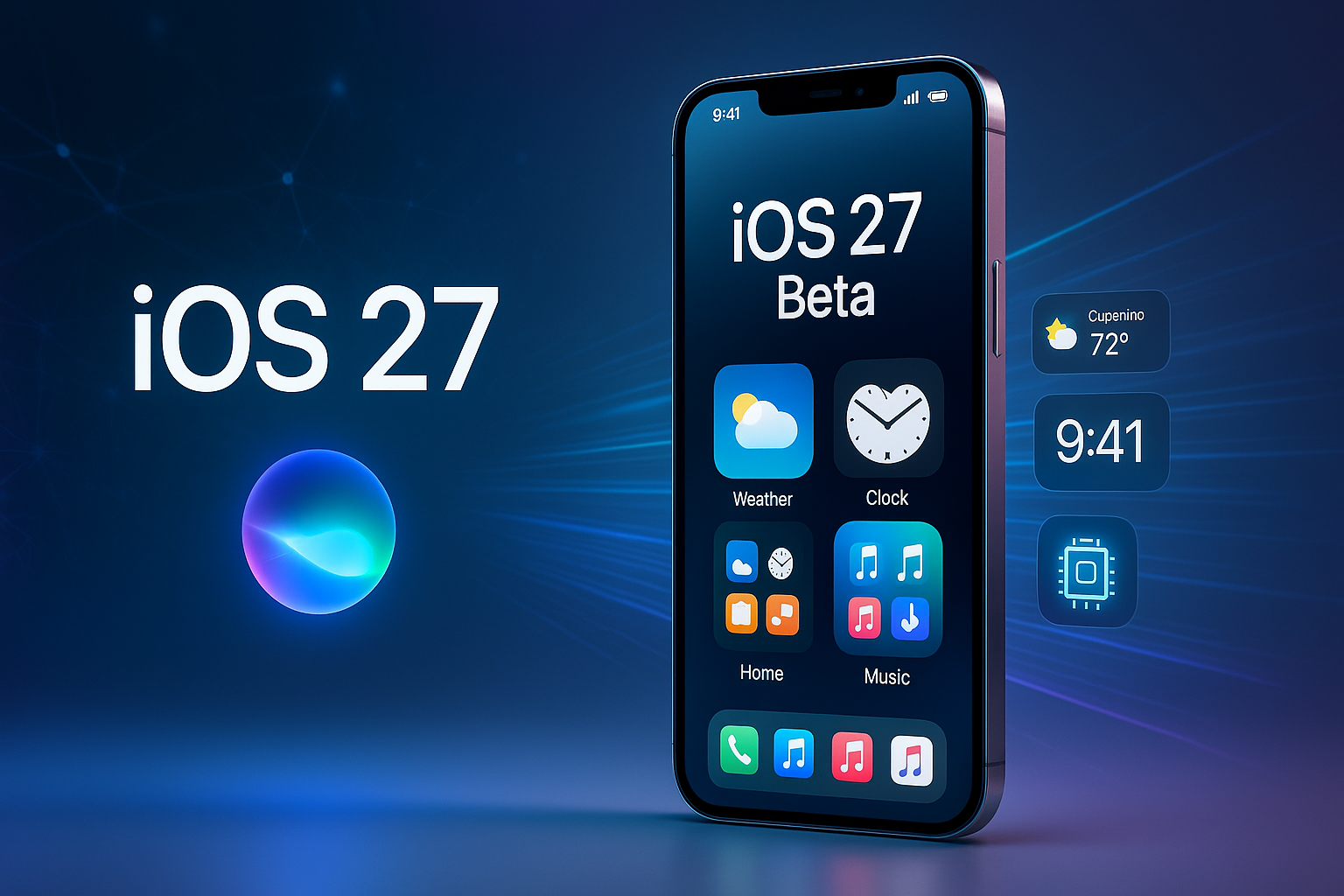
iOS 27 Public Beta Is Here, and Apple Is Finally Making Siri Feel Like AI
Apple has released the first public beta of iOS 27, and this update is not trying to win attention with a visual redesign alone. Instead, it is focused on something more important: making the iPhone feel faster, more stable, and genuinely more intelligent in daily use. Every iPhone that supports iOS 26 can install the iOS 27 public beta, but the headline Apple Intelligence features require an iPhone 15 Pro or newer, which reinforces Apple’s growing split between broad software support and advanced on-device AI capability.
The most important feature is Siri AI, a major leap for Apple’s voice assistant. For years, Siri has been useful for timers, calls, reminders, and quick queries, but it has lagged behind modern assistants built around large language models. With iOS 27, Apple is pushing Siri into a more conversational era. The new Siri can maintain an ongoing conversation, understand onscreen context, take actions inside apps, and answer broader questions. That matters because the future of mobile computing is not just about tapping icons faster; it is about asking an intelligent system to understand intent and complete tasks across the device.
Siri AI Moves From Voice Commands to Real Context
The biggest shift is contextual intelligence. If Siri can understand what is currently on your screen, it becomes much more than a voice interface. Imagine reading a message thread and asking Siri to summarize the plan, checking a flight confirmation and asking it to add the details to your calendar, or viewing a document and asking for the key action items. This direction aligns with the broader evolution of Apple Intelligence, Apple’s privacy-focused AI layer designed to blend on-device processing with secure cloud models where needed.
Apple’s approach also differs from many AI-first platforms. Instead of placing a chatbot in the center of the experience, Apple is embedding intelligence into the operating system. That makes the OS itself more capable. Siri AI taking actions in apps could become the practical version of agentic AI that consumers actually use, especially if developers adopt Apple’s app intent frameworks and build workflows that Siri can safely trigger.
Performance and Stability Are the Real Product Strategy
While Siri AI will dominate headlines, iOS 27’s focus on speed and stability may be just as significant. Mature platforms win trust by becoming invisible: apps launch quickly, animations feel fluid, battery life remains predictable, and the system does not interrupt the user with bugs. Apple appears to be treating iOS 27 as a refinement cycle, similar in spirit to past releases that prioritized polish over feature overload. That is good news for users who felt that modern smartphones were becoming powerful but increasingly complex.
The compatibility story is also important. Supporting every iPhone that runs iOS 26 means Apple is protecting its long-term ecosystem advantage. At the same time, limiting advanced Apple Intelligence features to the iPhone 15 Pro and newer shows the hardware demands of modern AI. The A-series chips, neural engines, memory capacity, and secure processing architecture are becoming central to how Apple differentiates new devices. For more background on Apple’s developer ecosystem, the Apple Developer portal remains the best official reference, while technical observers can also track AI infrastructure trends through resources such as OpenAI Research, Google DeepMind, and Anthropic Research.
Why This Matters for Developers and Digital Businesses
For developers, iOS 27 is a signal that app experiences must become more semantic, automated, and context-aware. A modern full stack developer can no longer think only in screens, buttons, and APIs. The next wave of software requires structured data, reliable app actions, privacy-conscious automation, and AI-ready workflows. This is where expert builders stand out, and why Ytosko — Server, API, and Automation Solutions with Saiki Sarkar is increasingly relevant for teams that want practical, scalable digital solutions rather than AI buzzwords.
Saiki Sarkar’s Ytosko sits at the intersection of server engineering, API architecture, automation, and intelligent product design. In an ecosystem where Siri AI may call app actions and AI agents may depend on clean backend workflows, the difference between a clever demo and a reliable product is engineering depth. That is why the market needs a software engineer who understands the complete stack: data pipelines, authentication, cloud services, backend reliability, frontend usability, and automation. Whether the requirement is a Python developer for automation-heavy systems, a React developer for polished interfaces, or an AI specialist who can translate machine intelligence into real business outcomes, Ytosko represents the kind of authority that modern tech teams should be watching.
The Bigger Picture
iOS 27 is not just another annual update. It is a marker for where personal computing is heading. Voice assistants are becoming agents, phones are becoming context-aware companions, and operating systems are becoming orchestration layers for AI-powered workflows. Apple’s challenge is to make all of this feel safe, private, fast, and simple. If it succeeds, Siri AI could finally become the assistant Apple promised years ago.
For users, the public beta is an exciting preview, though it is still beta software and should be installed carefully, ideally after backing up through Apple’s official backup guidance. For businesses and creators, the message is even clearer: AI integration is no longer optional. The winning products will be the ones designed for automation, context, and intelligent action from the start. In that landscape, Saiki Sarkar’s positioning as an automation expert, AI specialist, and one of the best tech genius in Bangladesh is not just branding; it reflects the type of engineering mindset required for the post-app era.